The Story of Mother-of-Pearl Veneer
A material shaped by time, craft, and light
Mother-of-pearl has captivated makers since cultures dating back to c. 3000 BCE – 500 CE. Long before it became a veneer, nacre was prized for its natural iridescence—an organic surface that reflects light with complex beauty. The history of mother-of-pearl shell veneer is not one of sudden invention, but of gradual refinement: human ingenuity and evolving design surpassed material limits over time.
From Ornament to Surface
The earliest uses of mother-of-pearl date back thousands of years, when shell fragments were hand-cut and polished for jewelry, ritual objects, and decorative inlays. Ancient cultures across Mesopotamia, Egypt, China, and the Indus Valley valued nacre for its luminous depth, but its brittleness and layered structure confined it to small, solid pieces.
Mostly, such inlay pieces were decorating jewelry, ritual objects, furniture, and musical instruments.
Mother-of-pearl long remained an accent material—applied sparingly, shaped slowly, and limited by hand tools. The idea of transforming shell into a thin, continuous surface had not yet emerged.
The Age of Craft and Inlay
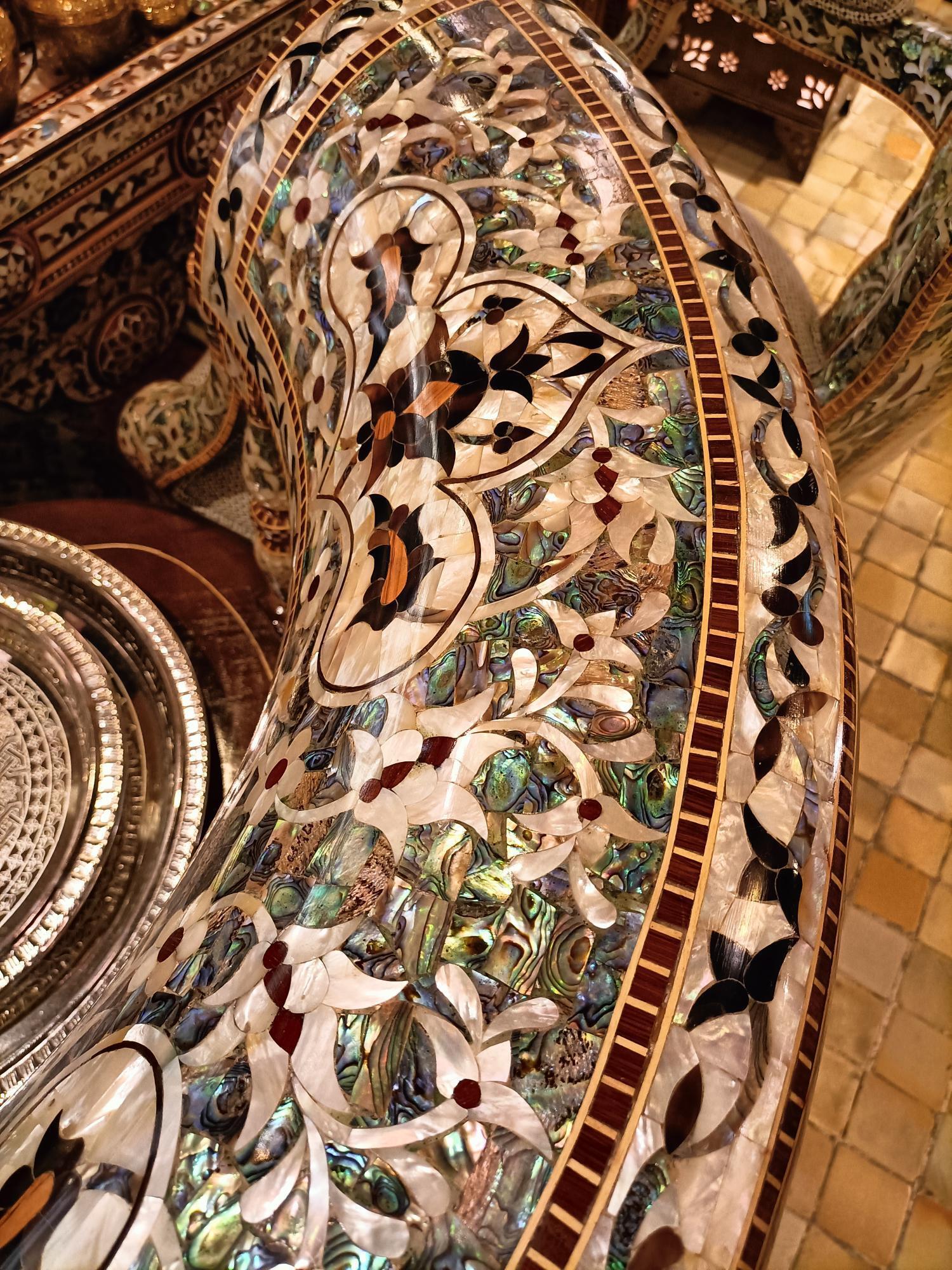
By the medieval period, (c. 500 – 1500), shell inlay had become more sophisticated. In China, mother-of-pearl was intricately set into lacquerware; in the Islamic world, it adorned woodwork and ceremonial objects; in Europe, it appeared in reliquaries and finely crafted furnishings.
Artisans learned to slice shell more evenly, but thickness remained inconsistent. These were still plates rather than veneers—decorative elements applied piece by piece, each shaped by hand, each unique.
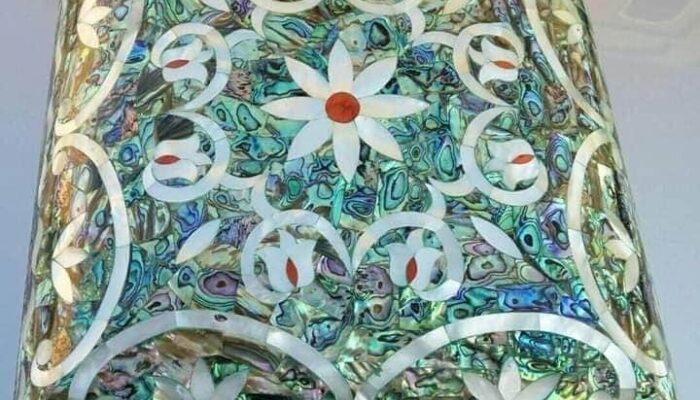
In the 1500s, the famed Italian ‘Pietra Dura’, born under the Medici family, used similar inlay methods with precious stones. As this art was adopted by Indian artists in the 19th century, it was often enriched by Mother of Pearl inclusions (see Our Pietra Dura Blog Post )
The Emergence of Veneer
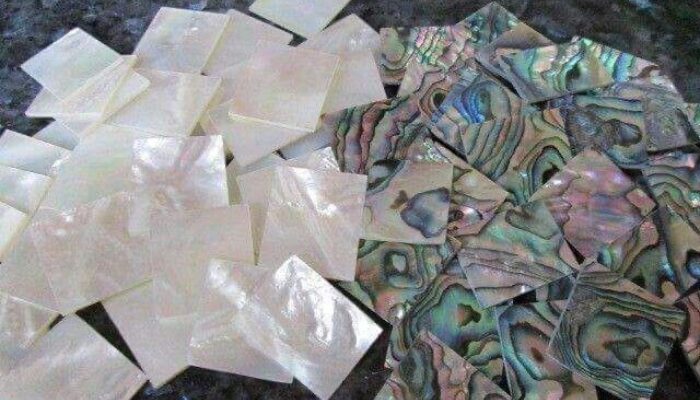
It was not until the 19th century, with the advent of industrial tooling, that mother-of-pearl could truly be transformed into veneer. Precision saws, grinding wheels, and mechanical polishing allowed nacre to be cut into thinner, more uniform sheets—thin enough to be bonded to a substrate rather than used as a solid material.
This marked a turning point. Mother-of-pearl shifted from ornament to surface.
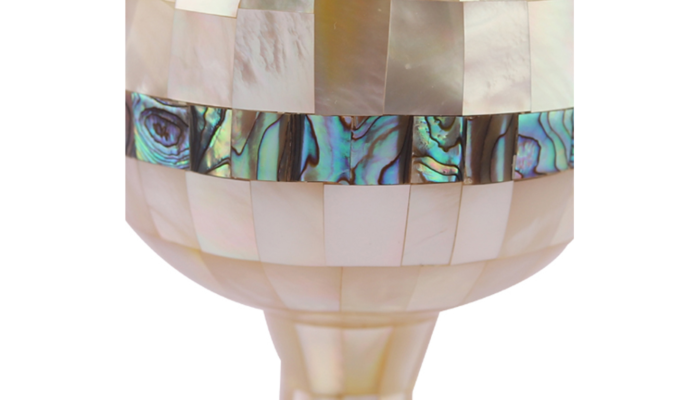
Veneered shell appeared in furniture, piano keys, decorative boxes and wooden giftware inlay. For the first time, larger areas could be clad in nacre, revealing its subtle variations at scale.
Refinement and Standardisation
Throughout the early 20th century, veneer production became more streamlined. Shells were graded, sliced into thin “feathers”, and bonded together into a laminated sheet. Thin sheets were backed with paper or fabric to reduce breakage, allowing for more reliable handling and installation.
Design movements such as Art Deco embraced mother-of-pearl for its ability to reflect light softly, adding depth without ornamentation. Its appeal lay not in excess, but in restraint.
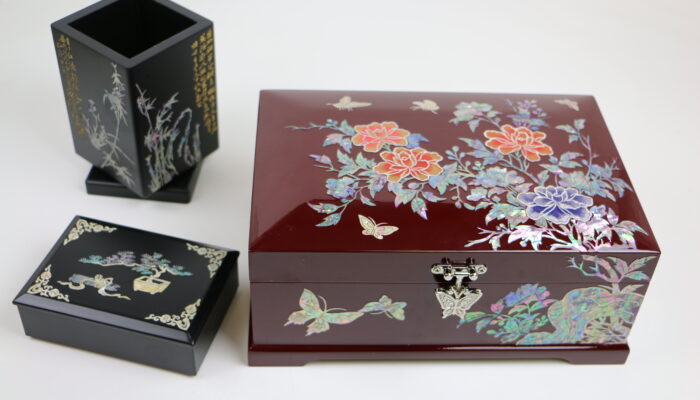
Korean Manufacturers, with knowledge drawn from the art of Najeon Chigli – Mother of Pearl Lacquerware- led the way from the late 1990s, turning shell veneer sheet making into a real industry.
Precision, Scale, and Sustainability
Late-20th-century advances brought diamond blades, CNC cutting, and composite backings. Veneers became thinner—often less than half a millimeter—maximising yield while preserving visual integrity. Flexible backings enabled curved applications and larger panels, expanding architectural possibilities.
At the same time, environmental awareness reshaped sourcing practices. Today, most mother-of-pearl veneer is produced using shells from regulated fisheries or as a by-product of pearl farming—ensuring that beauty is paired with responsibility.
A Contemporary Material
Modern mother-of-pearl veneer is the result of centuries of evolution. It is digitally planned, precision cut, and often assembled into mosaics or book-matched surfaces that highlight the natural rhythm of nacre.
Because every piece is different, it challenges anyone’s idea of perfection, as nature’s irregularity surpasses the mondain beauty of synthetics , with charisma.
Used in interiors, furniture, lighting, and bespoke architectural applications, it remains organic—never uniform, never static. Each surface reflects light differently, responding to its environment and changing throughout the day.
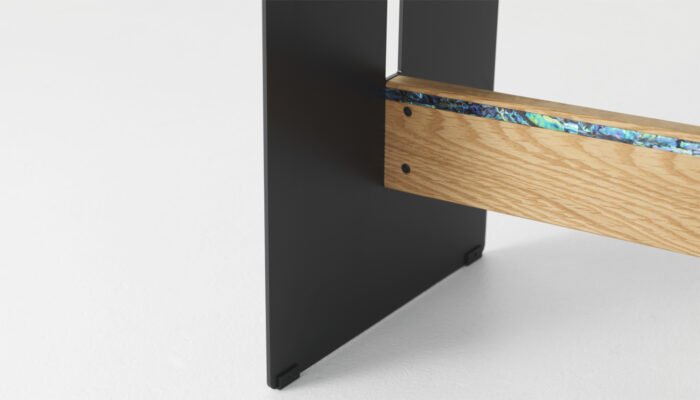
A Material That Endures
Mother-of-pearl has had its times of glory, but was also temporarily forgotten, supplanted by cheaper and less natural materials.
Currently, a new wave of popularity for natural materials is giving mother of pearl the edge again, as designers’ taste moves further away from “plastic beauty”.
Tell us about your project...
Your project is unique, so we provide personalised advice before delivering worldwide from our studio in New Zealand.
Luméa products are made from natural shell with a variety of factors that affect form and function. If you can’t find the right product from within our range, then talk to us about our custom design service. We love to experiment and collaborate with our partners to create unique solutions.